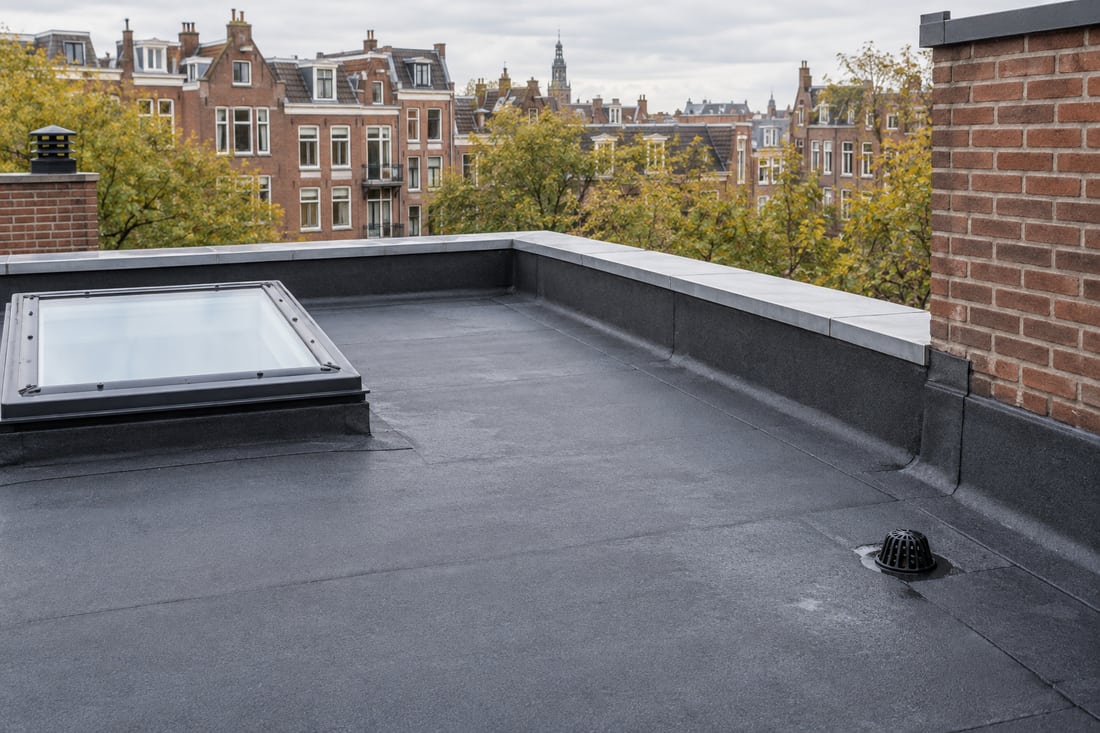
Persistent water on a flat roof is a reason to assess falls, outlets and roof condition. The size of a puddle in one photograph does not provide a full diagnosis. Record how it changes after rain and have the complete arrangement reviewed.
How do you describe where and when water remains?
Record whether water returns to the same location and how the situation changes after rainfall stops. A photograph without timing may show a temporary wet phase or a recurring drainage issue. Identify whether the area is an open roof surface, a zone beside a rooflight or a corner along a wall.
Observe only from a safe position; do not walk onto the roof to measure a puddle. A simple sketch can identify the location. If water also appears indoors, record that separately rather than assuming the external puddle and internal symptom necessarily have the same cause.
How do you distinguish falls from outlet problems?
Roof falls influence the direction in which water moves across the surface, while outlets must then carry it away. An obstructed outlet and an unsuitable roof shape are consequently different assessment questions. A local change in the substrate can also affect the water route. Ask how the complete roof drains, rather than only whether an outlet appears open.
Any emergency overflow provisions belong in the record too. Their presence or position alone does not establish that drainage is adequate for every situation. Calculations and technical design choices should be made by the responsible professional using the actual roof configuration.
Which covering and junction details matter?
Assessment of water accumulation should also consider seams, junctions and the condition of the covering. A new membrane can provide waterproofing without automatically correcting the route to an outlet. Added insulation or new roof components may alter that arrangement.
Mention recent changes to rooflights, edges or other structures. A proposal should distinguish repairs to the covering from improvements to drainage, explaining the expected result of each. This makes it clear which existing conditions will remain after the work and avoids interpreting “new roof covering” as a promise that every depression or drainage limitation has been removed.
How can the intended result be checked?
The recommendation should identify the component responsible for the problem or explain what further assessment is required. Ask how the proposed intervention will be checked at completion and which subsequent observations would be useful. Keep outlet maintenance and changes to the roof construction identifiable as separate tasks.
On a communal roof, several outlets or interfaces may be involved, so discuss the boundaries of the commission. Retain before-and-after photographs from the same safe position. A broad promise that the surface will always be completely dry is not a useful substitute for an explained design, defined work and appropriate checks.
Frequently asked questions
Does a puddle mean the roof is leaking?
No. Water on the roof and water indoors are separate observations. Drainage and the condition of the waterproof covering need assessment together.
Will new bitumen improve the roof falls?
A replacement covering does not automatically change the falls. If the roof shape requires alteration, that should be an explicit part of the proposal.
What information helps with an enquiry?
Describe the location, timing after rainfall, recurring pattern and known alterations. Include only photographs that can be taken safely from an existing position.
Consulted 19 September 2026. Check requirements for your own address and selected system.