Roofing terms, clearly explained
40 roofing terms in an A–Z glossary. Understand the materials, assemblies and arrangements in a Dutch roof proposal.
Discuss your roof ↗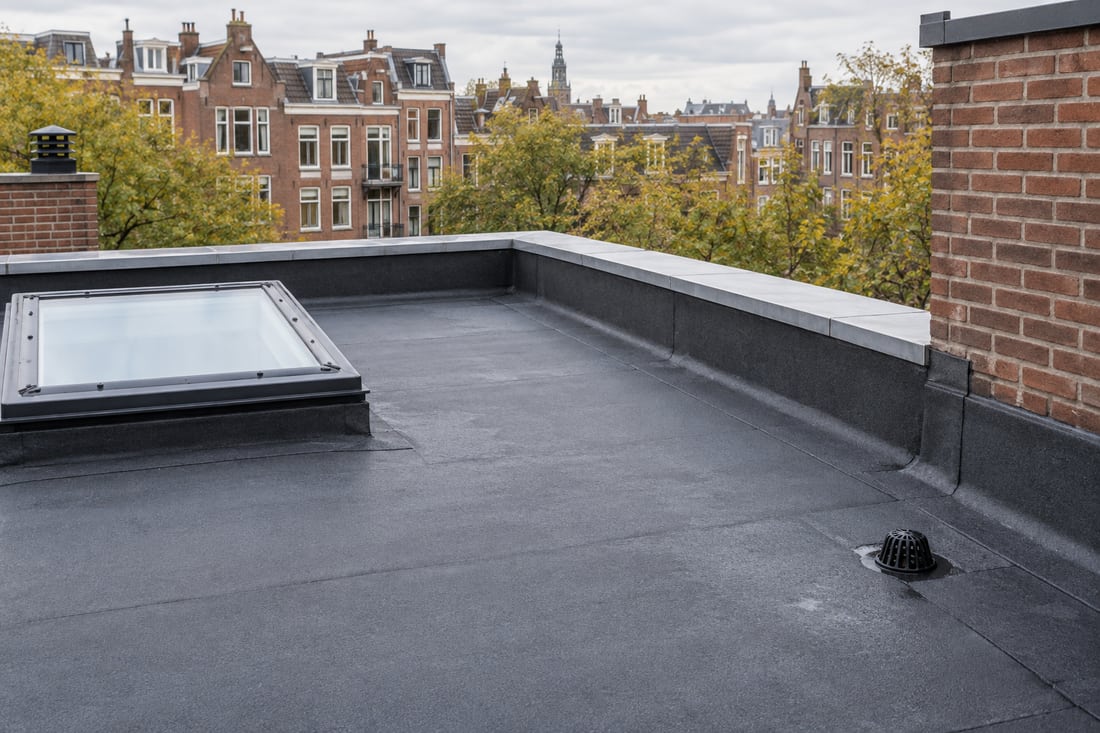
40 terms
B
2 termsBituminous roofing
Bitumen is a binder used in reinforced sheets for waterproof roof coverings. Bituminous systems differ in composition, layer arrangement and installation…
Read the explanation ↗Bonded roofing
Bonded roofing connects roof layers through adhesion using a suitable system. The term alone does not specify the product or application process used.
Read the explanation ↗C
5 termsCapillary action
Capillary action is the movement of water through narrow spaces or pores due to the properties of water and adjoining materials.
Read the explanation ↗Cavity flashing (spouwlood)
Cavity flashing is a water-resisting layer within or beside a cavity wall that directs cavity moisture towards an intended discharge point. The term…
Read the explanation ↗Cold roof
A cold roof places insulation on the internal side of the supporting roof structure, leaving that structure on the colder side of the insulation layer.
Read the explanation ↗Condensation
Condensation is the change of water vapour into liquid water when suitable conditions occur, for example on a cold surface within or against a roof…
Read the explanation ↗Counter-batten (tengel)
A counter-batten is a strip within the assembly beneath tile battens on a pitched roof. It contributes to the spacing and relationship between underlying…
Read the explanation ↗E
2 termsEmergency roof overflow
An emergency roof overflow is an additional drainage provision designed to offer an alternative outlet at a specified water level. It does not replace…
Read the explanation ↗EPDM roofing membrane
EPDM is a synthetic rubber used as a waterproof membrane on roofs, including flat roofs. The product family contains systems with specific requirements for…
Read the explanation ↗H
1 termsI
1 termsL
2 termsLead flashing (loodslab)
Lead flashing is shaped lead used in a weather-resistant junction, for example where a roof meets a chimney or wall. It forms part of a larger detail.
Read the explanation ↗Long-term maintenance plan (MJOP)
A long-term maintenance plan, or MJOP, organises building maintenance across several years. For roofing it provides a planning framework rather than a…
Read the explanation ↗M
2 termsMechanical fixing
Mechanical fixing secures components into a suitable substrate with physical fasteners. For roof coverings, the fixing arrangement belongs to a specified…
Read the explanation ↗Mineral wool
Mineral wool is a collective term for fibrous insulation materials, including glass wool and stone wool. Product form and properties determine the intended…
Read the explanation ↗O
1 termsP
1 termsR
15 termsRainwater drainage (hemelwaterafvoer)
Rainwater drainage is the arrangement collecting rainfall from a roof and carrying it onward. Roof outlets, gutters and downpipes may form connected parts…
Read the explanation ↗Rc value
The Rc value describes the thermal resistance of a complete construction, such as a roof assembly. It differs from the Rd value of an individual material layer.
Read the explanation ↗Rd value
The Rd value is the declared thermal resistance of a material layer at a specified thickness. For insulation it is product information, not automatically…
Read the explanation ↗Ridge tile (nokvorst)
A ridge tile is a shaped tile covering the upper junction between sloping roof surfaces. It works with its fixings and neighbouring components as part of…
Read the explanation ↗Roof ballast
Roof ballast is a weighted layer, such as gravel or paving, used within a designed roof system to help keep components in place.
Read the explanation ↗Roof blisters
Roof blisters are local raised areas within or beneath a roofing layer. Their appearance alone does not establish which layer has separated or what caused…
Read the explanation ↗Roof deck (dakbeschot)
The roof deck is the continuous layer of boards or sheet material forming part of the roof construction. Coverings and intermediate layers are arranged in…
Read the explanation ↗Roof edge trim (daktrim)
A roof edge trim is a finishing profile along the roof perimeter. Together with the covering connection, attachment and substrate, it forms the edge detail.
Read the explanation ↗Roof fall (afschot)
Roof fall is the slope directing water across a roof surface towards an outlet. It describes the geometry of the substrate or build-up, rather than the…
Read the explanation ↗Roof junction angle (kim)
A roof junction angle, called a kim in Dutch, is the transition between a roof surface and an upstanding construction component, where connected layers…
Read the explanation ↗Roof overlay
A roof overlay adds a new covering layer above an existing layer that remains wholly or partly in place. Retention requires assessment of the existing…
Read the explanation ↗Roof penetration (dakdoorvoer)
A roof penetration is an opening through the roof assembly for a component such as a ventilation duct or pipe. Its interface with the covering requires a…
Read the explanation ↗Roof underlay (onderdak)
Roof underlay is a protective layer beneath the visible covering of a pitched roof. Its specific function and properties depend on the selected product and…
Read the explanation ↗Roof valley channel (kilgoot)
A roof valley channel sits in the internal angle where sloping roof surfaces meet. It collects rainfall from adjacent slopes and directs it onward towards…
Read the explanation ↗Root-resistant layer
A root-resistant layer limits root penetration towards vulnerable parts of a green-roof system. Its function must suit the selected planting and other roof…
Read the explanation ↗S
1 termsT
3 termsThermal bridge
A thermal bridge is a location where heat flows out more readily than through neighbouring parts of a construction. The internal surface can consequently be…
Read the explanation ↗Tile batten (panlat)
A tile batten is a strip supporting the positioning of roof tiles within a pitched-roof assembly. Its arrangement needs to suit the tile system and…
Read the explanation ↗Torch application
Torch application is a method of installing suitable bituminous roofing sheets using heat. It is not a general application method for every type of roof…
Read the explanation ↗U
1 termsV
2 termsVapour control layer
A vapour control layer limits the passage of water vapour through a construction. Its role differs from the outer roof covering that resists rainwater.
Read the explanation ↗Vapour-permeable membrane
A vapour-permeable membrane allows water vapour to pass relatively readily within its intended application. The term alone does not establish its correct…
Read the explanation ↗W
1 termsFrom a roof question
to a clear plan.
A good plan starts at the top.
Schematic view. Actual roof construction requires an on-site assessment.